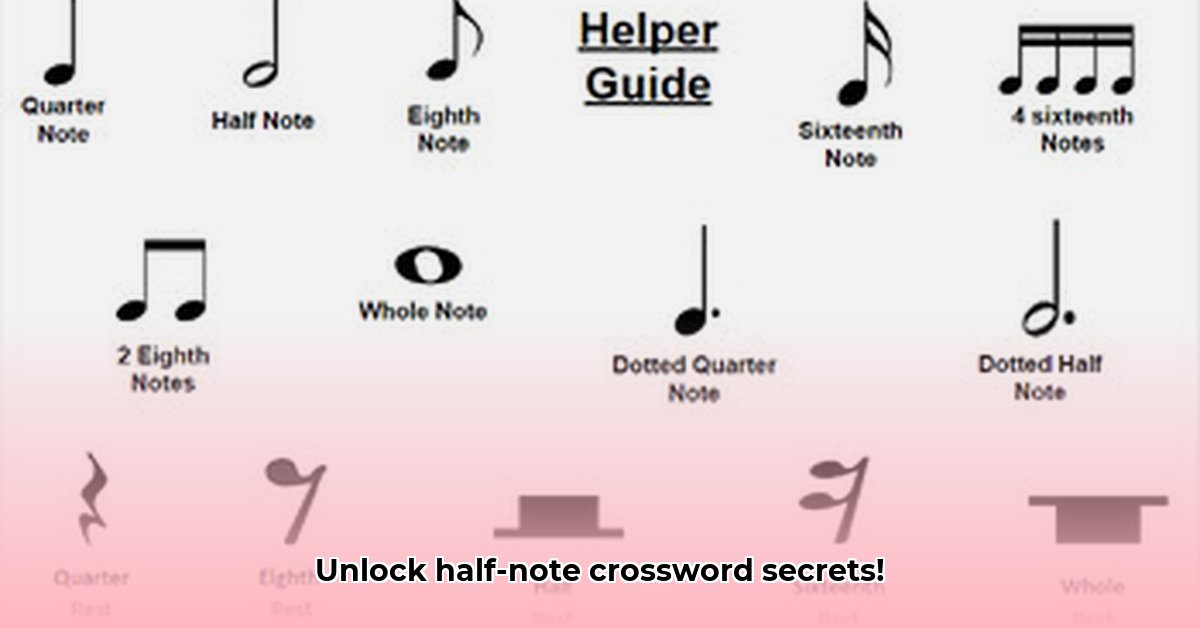
Half Note Crossword Clue: A Comprehensive Guide
Ever stared blankly at a crossword clue, especially a music-related one? The seemingly simple "Half Note" can be surprisingly tricky. This guide will equip you with the knowledge and strategies to conquer this musical puzzle, regardless of your music theory expertise. We'll not only reveal the primary solution but also explore alternative answers, teaching you how to approach ambiguous clues strategically. For more crossword clue help, check out this helpful resource.
Unlocking the Mystery: The Primary Solution
The most frequent answer to "Half Note" is minim. A minim is a half note in British and many international musical notation systems. In contrast, American notation uses the term "half note." This subtle difference is a favorite trick of crossword constructors! Understanding this regional variation is crucial to solving the clue.
(Placeholder image of a minim/half note needed here)
Did you know that a minim's duration is twice that of a crotchet (quarter note)? This simple fact highlights the inherent relationship between musical note lengths and how they might be used in wordplay within a crossword.
Beyond the Minim: Exploring Alternative Solutions
While "minim" is the go-to answer, crossword puzzles often employ wordplay. Therefore, alternative valid solutions exist. Let's explore them:
Crotchet (or Quarter Note): A crotchet is half a minim. In a cryptic crossword, this relationship might be exploited, making "crotchet" a valid, albeit less common, solution. This highlights the importance of considering the puzzle's complexity.
Semitone: This term refers to a musical interval (half-step). While not directly related to note duration, the "half" element could justify its use in highly ambiguous or cryptic clues. This demonstrates the creative interpretation needed for some crossword clues.
Mastering Ambiguous Clues: Strategic Approaches
Tackling ambiguous clues involves a multifaceted approach that combines musical understanding and strategic problem-solving.
Word Length: Always check the number of letters required for the answer. This immediately eliminates many possibilities, significantly streamlining your search.
Intersecting Words: Look at the letters already filled in from intersecting words in the crossword grid. These intersecting words may reveal critical letters or narrow down your options. Can you see how intersecting clues work together to unlock the final answer?
Theme Awareness: Some crosswords have overarching themes (e.g., music history, musical instruments). If a theme is present, consider how the "Half Note" clue fits within that context. This will help you anticipate potential answers, aligning your approach with the crossword’s overall puzzle theme.
Online Resources (Used Sparingly): Online crossword solvers are valuable resources, but over-reliance hinders learning. Use them judiciously to verify a suspected solution after you've made considerable progress using your own expertise and creative thinking.
Advanced Techniques: Decoding Cryptic Clues
Cryptic crosswords introduce an additional layer of complexity, relying heavily on wordplay, double meanings, and homophones. A cryptic clue might use metaphorical phrasing, making the connection to "half note" indirect and requiring astute observation of the clue's words and phrases. Knowing how to solve ambiguous clues involves understanding such subtle nuances.
Conclusion: Mastering the Musical Crossword
The "Half Note" clue perfectly illustrates the ambiguity and wordplay inherent in crossword puzzles. While "minim" remains the primary solution, recognizing the potential for creative interpretations—leading to answers like "crotchet" or "semitone"—distinguishes a proficient solver from a casual one. Combining musical knowledge with strategic problem-solving techniques, including checking word length, examining intersecting words, and paying attention to the puzzle’s theme, transforms this challenge into an enjoyable learning opportunity. Remember the power of strategic puzzle-solving and keep practicing to sharpen your skills!